

A six-month journey to future-proof Upwardly Global’s data infrastructure
After 25 years of supporting skilled immigrants and refugees in their career journeys, Upwardly Global recognized the need to modernize our data systems. With artificial intelligence and advanced analytics becoming increasingly important for nonprofit impact measurement, we knew it was time for a comprehensive overhaul of our 12-year-old Salesforce database.
This post outlines our journey, key insights, and the roadmap we’ve developed to ensure our data infrastructure can support both our current mission and future innovations.
Why This Project Mattered
Our Salesforce database has been the backbone of our operations, tracking participant journeys, program outcomes, and organizational impact. But like many systems that evolve over time, it had become layered with outdated processes, redundant tools, and legacy data.
To prepare for AI-powered tools that can enhance participant matching, predict outcomes, and optimize programs, we needed a clean, well-structured data foundation.
Our Six-Month Journey
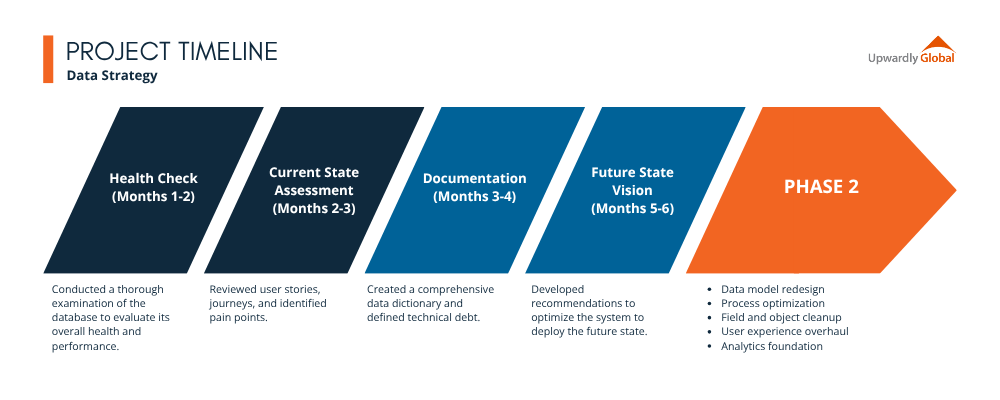
Months 1 to 2: Health Check
We began with a full diagnostic of our database, focusing on:
- Database size and growth trends.
- Performance bottlenecks.
- Security vulnerabilities and compliance.
- Data integrity and relationships.
This revealed several opportunities for improvement, including outdated fields, redundant objects, and inefficient workflows.
Months 2 to 3: Understanding the Current State
Next, we reviewed how different stakeholders use the database in their daily work to:
- Identify key user roles and their data requirements.
- Map user journeys to better understand their workflows.
- Understand data flows to support future AI-driven personalization.
- Identify pain points and inefficiencies.
We found that while the system had evolved with regular updates, many legacy elements remained, creating clutter and confusion.
Months 3 to 4: Building Our Data Dictionary
One of our most important tasks was creating a comprehensive catalog of all the information in our system. Creating this “data dictionary” involved:
- Cataloging all database objects, fields, and their relationships.
- Defining data types, validation rules, and usage guidelines.
- Documenting data sources, as well as defining ownership and stewardship responsibilities.
- Standardizing data to ensure clean, structured inputs for ensuring reliable outputs from AI-enhanced systems.
Months 5 to 6: Envisioning the Future
Finally, we developed a strategic vision for where we want our data systems to be in the next few years. Key priorities included:
- Streamlining architecture by removing outdated elements.
- Implementing better data governance practices.
- Improving user experience for our team.
- Preparing for AI integration and advanced analytics.
Why AI Needs Clean Data
AI is only as good as the data it relies on. Inconsistent, outdated, or siloed data can limit their ability to deliver accurate insights, helpful recommendations, and effective automations.
By modernizing our data foundation, we’re ensuring that our systems are ready to support AI-powered tools that can provide real-time insights, enable predictive analytics, and streamline workflows. Clean, well-structured data helps these tools operate with greater accuracy, fairness, and impact.
What We Learned: Key Recommendations
1. Collaboration is key.
-
- Host regular cross-departmental meetings to align on data needs and challenges, especially as AI use cases emerge across teams.
- Create a shared knowledge base for documenting practices and lessons learned.
- Establish a data and AI governance committee with representatives from each team to oversee data quality, ethical AI use, and cross-functional alignment.
2. Invest in the right tools.
-
- Evaluate and adopt tools that support data integration, analytics, automation and AI-powered features such as intelligent recommendations and predictive dashboards.
- Invest in automated tools for data quality management — cleansing, validation, and monitoring.
- Leverage cloud-based data management solutions for scalability, flexibility, and remote access.
3. Prioritize regular maintenance.
-
- Schedule periodic health checks to monitor performance, security, and data integrity. Regular evaluations help identify and address issues before they escalate, ensuring smooth operation.
- Use real-time monitoring tools to catch and resolve issues early.
4. Keep users at the center.
-
- Actively involve users in the evaluation and optimization process by gathering feedback through surveys, focus groups, and user testing.
- Develop training programs to ensure users can fully leverage the system’s capabilities and use AI ethically.
5. Document everything.
-
- Maintain up-to-date documentation for workflows, data definitions, and troubleshooting to ensure clarity, consistency, and aid in onboarding new team members.
- Regularly review and revise documentation to reflect system changes, keeping everyone aligned and informed.
Looking Ahead: Phase 2
With the foundation laid, we’re now focused on implementation — ensuring our systems are modern and ready to integrate AI tools that can enhance efficiency. Our next steps include:
- Redesigning Our Data Architecture: Restructuring information organization to match how our programs actually work and ensuring our data is clean, consistent, and accessible for AI tools to interact with effectively.
- Streamlining Workflows: Automating routine, manual tasks and eliminating redundant steps.
- Cleaning House: Archiving or removing outdated fields and features that no longer serve a purpose.
- Improving the User Experience: Updating interfaces, permissions, and training materials to support better adoption and preparing users to engage with new AI-enhanced features.
- Building Our Analytics Foundation: Establishing data quality and structure for more strategic reporting and AI-powered insights.
We are committed to continuous improvement and innovation to ensure our Salesforce database evolves into a platform that supports both our mission today and the intelligent tools of tomorrow.
Moving Forward Together
Modernizing a 12-year-old database system is a significant undertaking, but it’s an investment in our organization’s future and our participants’ success. By taking a comprehensive, user-centered approach, we’ve created a roadmap that supports both current operations and future innovations.
As we enter an era where AI and advanced analytics can significantly enhance nonprofit impact, having a solid data foundation is essential. Our internal efforts to modernize our systems are complemented by external partnerships — like our collaboration with HiredScore (see: Upwardly Global Fetch) — to ensure that AI is used not just efficiently, but ethically and inclusively.
We’re excited about the possibilities ahead and committed to ensuring our data infrastructure supports our mission and the communities we serve for years to come.